

Article: Quicksilver: What the Alchemists Understood About Change
Quicksilver: What the Alchemists Understood About Change
Spill a little mercury on a table and it does what no other metal will. It refuses to lie flat. It gathers into bright, trembling spheres, divides at a touch, and rejoins when the pieces meet, as though nothing had ever been broken. It is a metal that behaves like a liquid, and a liquid that behaves like a mirror.
Everyone who has studied it, from the earliest alchemists onward, seems to have felt the same quiet unease. Here is a substance that will not be held.
A Metal That Would Not Stay
The Greeks called it hydrargyros, water-silver. The Romans named it for Mercury, the swift messenger who alone among the gods moved freely between heaven, earth, and the underworld. The name was never decoration. For the alchemists, mercury was less a material than a principle: the volatile, the fluid, the thing that carries one state into another.
Medieval and Renaissance texts pair it with sulfur, the fixed and fiery, as the twin parents of all metals. Their most famous instruction was solve et coagula: dissolve, then bring together again.
Alchemy is often remembered as a failed ambition to make gold. I prefer the older reading, in which the gold was never the point. The point was the person at the bench, who was meant to be changed by the work.
I find it moving that they understood transformation as two motions rather than one leap. Something must come apart before anything new can form. Most of us accept the second half of that sentence readily and resist the first.
They were also honest about the cost. Mercury is poisonous, and many who pursued its secrets paid with their health. The old practitioners knew what we tend to forget: change has never been free of risk, and anyone who promises otherwise has not looked closely.
The Liquid Mirror
Artists have never been able to leave it alone. In 1937, Alexander Calder built a fountain for the Spanish Republic’s pavilion at the Paris World’s Fair, in which mercury from the mines at Almadén flowed over a series of curved plates. I like to imagine what it meant to present, in a year of such upheaval, a silver surface that would not hold still. Today the fountain is kept behind glass at the Fundació Joan Miró in Barcelona, because we have since learned what the substance can do. Even so, one can stand before it and feel something loosen.
Carl Jung spent years among the alchemical texts and wrote of Mercurius as a figure of paradox: spirit and matter, poison and cure, a thing that cannot be described without contradicting itself. I take comfort in that. It suggests the discomfort of being unfinished is not a malfunction. It may be the material itself.
When It Rains Mercury
When I made Mercury Falling, one image stayed with me: a city of concrete and glass, and above it, a storm. In the story of the collection, mercury falls like rain over the concrete jungle while Zeus, the cloud-gatherer of the old myths, crafts the weather. Those beneath it face a choice. In the version I wrote, the answer is love, the one force that can rise above the atmosphere and see the weather from outside it.
What I wanted to say is what the alchemists seemed to know: the storm is not an interruption of the work. It is the work.
I have come to believe that some change cannot be managed. It can only be accompanied. You do not command mercury into a shape. You learn its nature, you hold the vessel steady, and you stay.
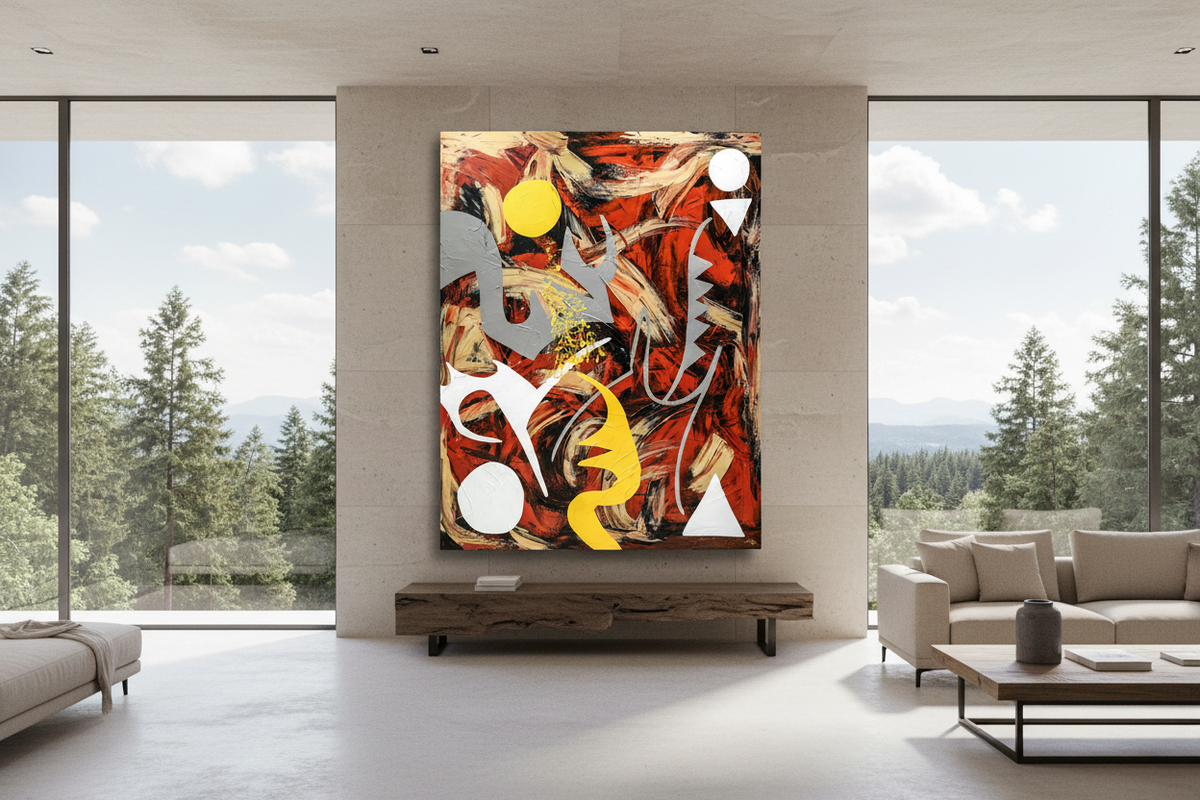
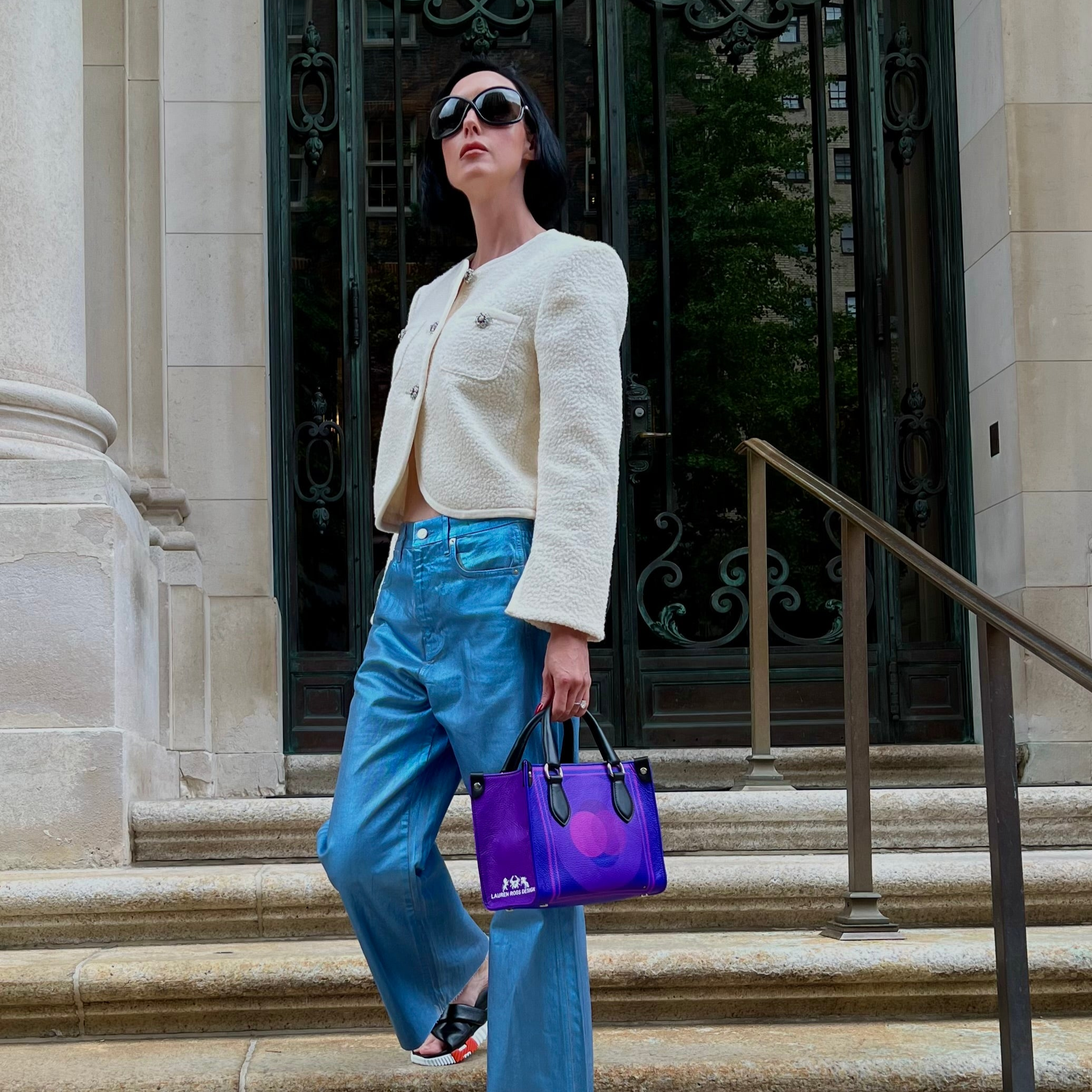
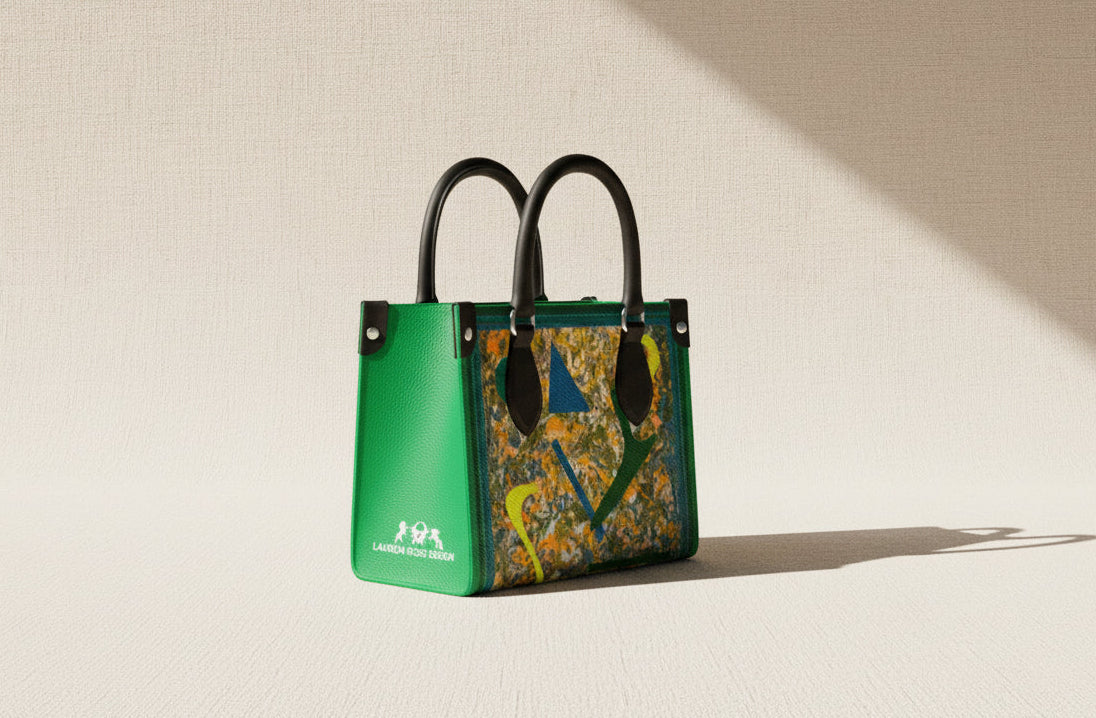
That belief lives in the collection in small ways. A silk scarf, which moves as you move and is never quite the same shape twice. A handbag, carried through ordinary days, that keeps you company from one version of yourself to the next. A painting called Concrete Jungle, which holds the storm still long enough to look at it.
The Fear of Formlessness
We are asked, constantly, to hold a shape: a title, a brand, a story about ourselves told so many times it hardens. There is a quiet fear in all of it, that if we loosen our grip on the form, nothing will be left. Mercury suggests otherwise. Break it into a hundred droplets and it is still entirely itself, and it gathers again when the time comes. Its identity was never in its shape. It was in its nature.
I think about this when I watch a canvas move from gesture to composition, and when I watch someone I love in the middle of an ending. There is always a moment when what was has dissolved and what will be has not yet formed. Everything in us wants to hurry through it. The alchemists lingered. They understood that the middle is where the work happens.
The question they leave us is not how to turn lead into gold. It is what in us is lead, what is waiting to become silver, and whether we are willing to be, for a while, neither.
There is a saying, 'When it rains, it pours'. But the truth is, it must pour before the rainbow appears.
What shape are you holding that you have already outgrown? And what might gather itself again, if you let it fall?
If the question lingers, I invite you to spend some time with Drop 002: Mercury Falling.